
The FCA's authorisation gateway for the new UK cryptoasset regime opened at 9:00am on 30 September 2026. The application period closes at 11:59pm on 28 February 2027. Which side of that line you file on decides what happens to your UK business on 25 October 2027, when the regime comes fully into force.
File inside the window and, if the FCA has not decided your application by commencement, you can keep providing cryptoasset services under the saving provision until your application has been finally determined. File after the window closes but before commencement and, unless you are authorised by then, you enter the transitional provision, which confines you to performing contracts you had already entered into. Do not file at all and you must run off your UK business before the regime starts.
Below we set out how the FCA says the gateway will operate, and what to do with the time that is left.
Who has to apply
Any firm that wants to carry on one of the new cryptoasset regulated activities must be authorised by the FCA under the Financial Services and Markets Act 2000 (FSMA), with permission for those activities.
That includes firms already registered with the FCA under the Money Laundering, Terrorist Financing and Transfer of Funds (Information on the Payer) Regulations 2017 (MLRs), and firms registered with or authorised by the FCA under The Payment Services Regulations 2017 or The Electronic Money Regulations 2011.
If you are MLR-registered, read this twice. The FCA states that "there will be no automatic conversion". You need FSMA authorisation in your own right.
If you are already authorised under FSMA for other regulated activities, you apply to vary your existing permissions.
If another FCA-authorised firm currently approves your financial promotions (a s.21 approver), the FCA directs you to its Cryptoassets: Use of s.21 approvers page.
The application period: 30 September 2026 to 28 February 2027
Part 7 of the Treasury's Statutory Instrument, the Financial Services and Markets Act 2000 (Cryptoassets) Regulations 2026, requires the FCA, not later than one year before full commencement, to specify by direction an application period: a period before the regime commences during which firms can apply for authorisation, or for a variation of permission if they are already authorised under FSMA.
The Regulations set two limits. The period "must have a duration of at least 28 days", and its last day "must be at least 28 days before the full commencement day" (regulation 52(2)).
The FCA's direction of 20 February 2026 fixes the dates: the period "will commence at 9:00am 30 September 2026 and will end at 11:59pm 28 February 2027". Full commencement is 25 October 2027.
Two further points follow from regulation 52. First, the FCA may amend or replace its direction to extend the period (regulation 52(3)). Do not plan on it. Second, "A direction under paragraph (1) does not prevent applications for a relevant cryptoasset permission being made outside the relevant application period" (regulation 52(5)). You can apply late. What you lose by doing so is set out below.
Before you apply: the pre-application support service
Firms can still request a meeting through the FCA's pre-application support service (PASS). It is optional and free of charge. It gives you the opportunity to introduce and explain your business model, discuss the authorisation process and understand the FCA's expectations. The FCA says it helps firms prepare high-quality applications and often facilitates faster assessments and decisions.
The entry price is higher than many firms expect. A PASS request must give the FCA information about your proposed business model, products and services, and customer types, and that information should include analysis of the regulated activities you intend to apply for. The FCA may ask for any legal advice that supports that analysis.
The FCA is blunt about the rest: "We will reject requests for pre-application meetings that aren't accompanied by meaningful supporting information." And: "It’s not sufficient for firms to include a commitment to provide further information once the pre-application meeting has been booked."
Applicants should also note that "we do not provide advice to firms and pre-application meetings do not guarantee a successful application". The FCA says applicants should consider seeking independent legal or compliance advice as part of preparing an application.
The practical point: PASS will not do your perimeter analysis for you. Your perimeter analysis is what gets you through the door.
What the application involves
Applications are submitted through the FCA's Connect system. If you are not yet set up, register for Connect now.
The FCA has published three documents to work from:
- an information document covering both the components of the authorisation application form that any FSMA applicant completes and the cryptoasset-specific sections, which are driven by your business model;
- the cryptoasset form for VoP applications, which already-authorised firms adding cryptoasset activities submit as part of their variation of permission application; and
- an updated financial data template, which applicants are required to complete.
The FCA also asks firms to familiarise themselves with the application period and how it interacts with the saving and transitional provisions. That interaction is where the real decisions sit. The FCA's general guidance on the process is on its authorisation process page.
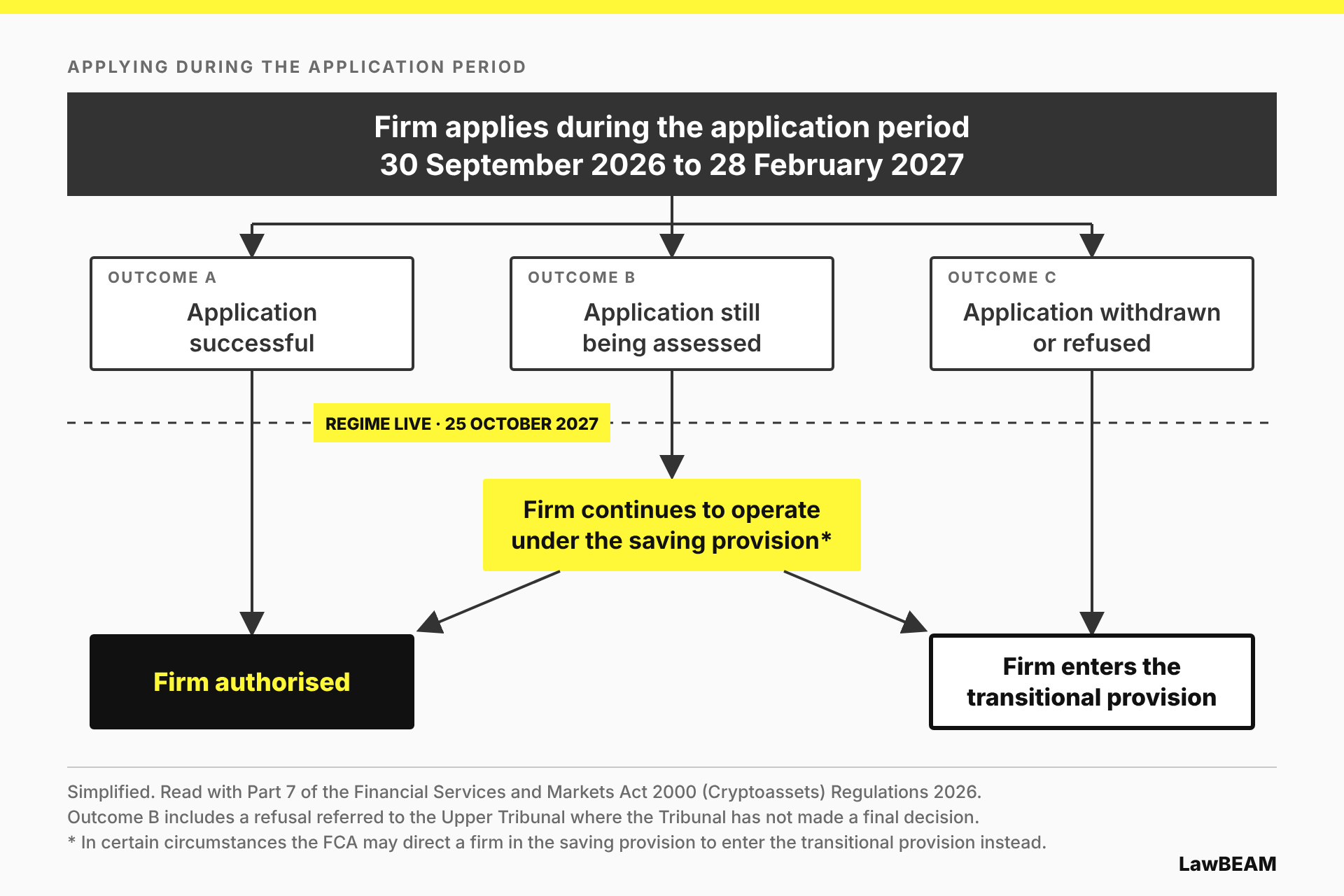
Apply in the window: the saving provision
If you apply during the application period, the FCA expects to determine your application before the new regime commences.
If it does not, the Treasury's Statutory Instrument contains a saving provision. It lets you continue to provide cryptoasset services until your application has been finally determined. That includes the case where you have referred the FCA's decision to refuse your application to the Upper Tribunal and the Tribunal has not made a final decision.
Where that happens, the Statutory Instrument also allows the FCA, under certain circumstances, to direct that you enter the transitional provision rather than the saving provision. The FCA's transitional provision page says it may do so where a refused application is still open to review and it considers this necessary for the "prevention, detection, investigation or prosecution of a criminal offence", the "protection of consumers" or the "advancement of our objectives".
If the Tribunal agrees with the FCA's decision to refuse, you enter the transitional provision so that you can exit the UK market in an orderly manner. If the Tribunal disagrees, it can overturn the FCA's decision, vary it, or remit it to the FCA with directions to reconsider.
Firms using the saving provision must notify the FCA as soon as reasonably practicable after the full commencement date, and again when they are no longer using it. The FCA will set out how to make those notifications in a direction published on its website.
The diagram below summarises the position for firms that apply during the application period.
Apply late: the transitional provision
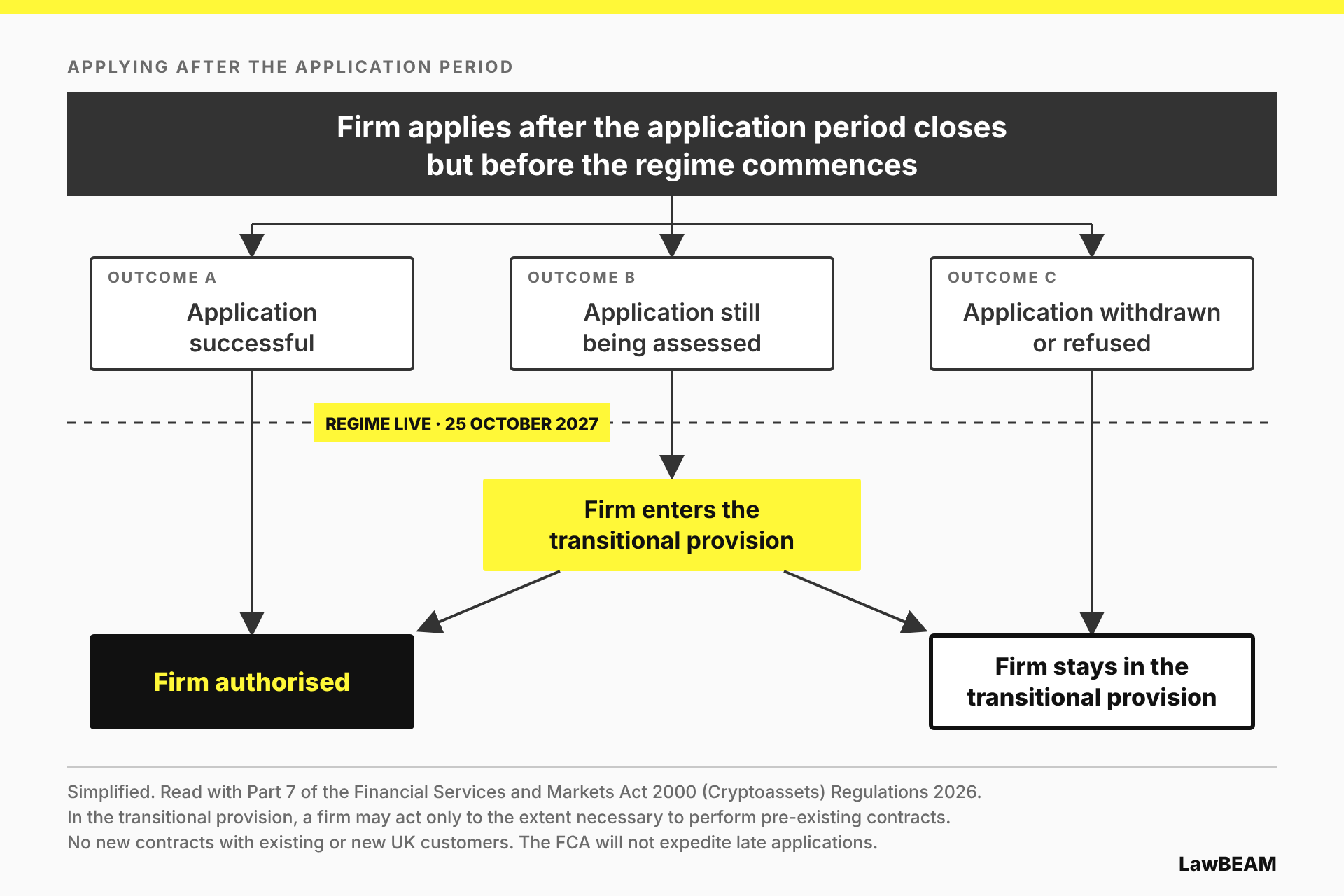
The FCA expects firms to apply during the application period, but you can apply outside it. If you do, the FCA is clear that "we will not expedite our assessment of a firm's application to compensate for its late submission (ie after the application period has closed)".
If you apply after the window closes but before the full regime commences, and you are not authorised with the required permissions by that date, you enter the transitional provision by operation of law at the point the regime goes live, while your application is determined.
Inside the transitional provision you must adhere to its requirements, and you can carry on the new UK regulated cryptoasset activities only "to the extent necessary for the performance of a pre-existing contract entered into before the firm entered the transitional provision". You cannot enter into new contracts with existing UK customers. You cannot enter into new contracts with new UK customers.
The transitional provision is built for run-off. The FCA describes it as allowing firms "to wind down their remaining UK business over a maximum two-year period", and while in it a firm "may only communicate financial promotions that are necessary for the performance of a pre-existing contract". For a growing business, that means no new UK business from the day the regime goes live until you are authorised, and no promise that the FCA will move quickly.
The diagram below summarises the position for firms that apply after the application period.
Do not apply: run off before commencement
Firms that do not intend to apply, or that ultimately do not apply, for authorisation or variation before the new regime commences must run off their UK cryptoasset business before it commences. They have no access to the saving or transitional provisions.
A firm that fails to run off its UK business in time could be at risk of conducting unauthorised business and breaching the general prohibition in section 19 of FSMA or, if it is already authorised under FSMA, acting without permission under section 20 of FSMA.
One trap sits on the FCA's transitional provision page rather than the gateway page: "Firms that submit an application that is rejected by us (ie it does not include the minimum information we ask for) and that do not subsequently submit a valid application will be considered as not having applied." A thin application filed to beat the deadline buys nothing. It can leave you in the run-off category.
What to do now
- Settle your perimeter. Establish which regulated cryptoasset activities you carry on, from where, and for whom. Your permissions, your application and your access to PASS all depend on it.
- Get onto Connect. Register, then work through the FCA's information document and financial data template against your business model.
- Do not assume your status carries over. MLR registration, registration or authorisation under the Payment Services Regulations 2017 or the Electronic Money Regulations 2011, and a s.21 approver relationship are not authorisation for the new activities.
- File a complete application inside the window. 11:59pm on 28 February 2027 is the last moment to apply within the application period, and so to have access to the saving provision. A rejected application that is not replaced by a valid one counts as no application.
- If you will not apply, plan the run-off now. It must be complete before 25 October 2027.
How we can help
LawBEAM advises exchanges, custodians, stablecoin issuers, staking providers and intermediaries on UK cryptoasset regulation and FCA authorisation. We establish your perimeter position, prepare the regulated-activities analysis the FCA expects to see with a PASS request, and plan and prepare your application so that it is complete and filed inside the window.
For a first, confidential reading, use our free UK Cryptoasset Perimeter Scanner. For a formal answer, instruct our fixed-fee UK Perimeter Analysis.
Further reading
From the FCA:
- Cryptoassets: How the gateway will operate (the source page for this insight)
- A new regime for cryptoasset regulation
- What you need to do when preparing for the new cryptoasset regulatory regime
- Cryptoasset regulated activities: FSMA and the FCA Handbook
- Cryptoassets: Our standards
- Cryptoasset firms: Authorisation, supervision and enforcement
- Cryptoassets: The transitional provision
- Cryptoassets: Use of s.21 approvers
- Cryptoasset firms: Registration under the MLRs ahead of the new FSMA regime
From LawBEAM:
- The FCA Cryptoasset Authorisation Window Opens on 30 September 2026
- The FCA Finalises the UK Cryptoasset Regime: Final Rules Published
Contact us
Contact us to scope your perimeter, prepare for a PASS meeting, or plan your application.

Roshi Sharma
Founding Partner
Email: roshi@lawbeam.io
Tel: +44 (0) 7815 610 474
LinkedIn: linkedin.com/in/roshi-sharma-lawbeam
This insight is provided for general information only and does not constitute legal advice. It reflects the FCA's page Cryptoassets: How the gateway will operate (last updated 30 September 2026), the FCA's page Cryptoassets: The transitional provision (last updated 24 August 2026), the FCA's direction of 20 February 2026 and the Financial Services and Markets Act 2000 (Cryptoassets) Regulations 2026 (SI 2026/102), as at 1 October 2026. The diagrams are simplified and should be read with Part 7 of the Regulations. For advice on your specific circumstances, please contact us.